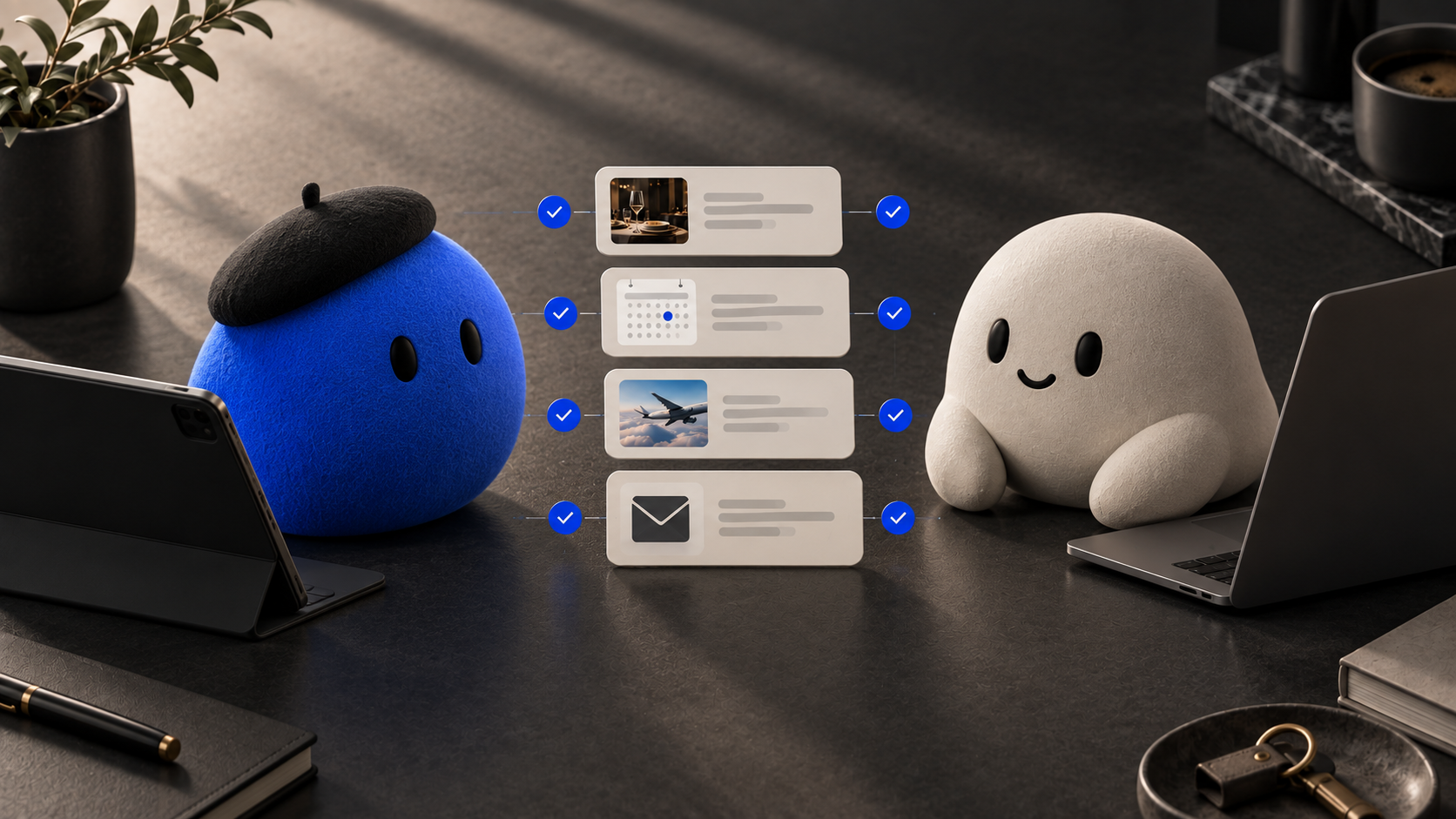
I did not expect ChatGPT’s Dot and Meta’s Muse to be so good at normal things.
Not complex demonstrations built to show what an AI agent might eventually do. I mean the ordinary tasks that take time and attention throughout the week: booking reservations, checking flights, responding to emails, sending text messages, monitoring important messages, and remembering things I did not want to lose track of.
I gave both agents similar work. In most cases, they handled it with very little guidance from me.
That was the first surprise.
OpenAI describes Dot → as an always-on agent inside ChatGPT. It is powered by GPT-6 Astra, has its own cloud computer, works across applications a user chooses to connect, and turns to the user for decisions that require judgment.
Meta describes Muse → as a personal agent that runs in its own secure cloud computer, called Muse Secure VM. It can use a browser and connected applications, continue working after the app is closed, and request approval before sensitive actions.
Those descriptions explain how the products work. Using them showed me what those capabilities feel like in practice.
I gave them real work
I did not spend much time creating elaborate instructions. I told them what I needed in roughly the same way I would explain it to another person.
Find a reservation. Check flight options. Reply to this email. Send this text. Let me know when an important message arrives. Remember this for me.
During my testing, both agents were able to work through most of the intermediate steps without requiring me to direct every action. They navigated websites, used connected applications, entered information, and stopped when they reached something that required my involvement.
In the tasks I ran, they did almost everything except enter my credit card details.
The value was not that either agent could perform one extraordinary task. It was that they could complete a series of ordinary ones with very little management from me.
The Paris reservation made it feel real
I have a birthday dinner in Paris coming up in November. I told Dot what I was looking for, and it found a restaurant that fit.
It then booked the reservation for me.
After the reservation was confirmed, Dot contacted the restaurant by email in French to ask follow-up questions, including whether they could accommodate a specific seating arrangement.
That sequence is what made the experience feel different. Dot did not simply recommend a restaurant or draft a message for me. It found the restaurant, made the reservation, determined how to contact the staff, wrote to them in the appropriate language, and followed up on the details.
With a conventional chatbot, I would still have needed to evaluate the options, visit the booking site, complete the reservation, find the restaurant’s contact information, copy a translated message into my email, and track the response myself.
Dot worked across the entire process for me.
Dot started with more context
Dot had one clear advantage in my testing: it began with more context about me.
OpenAI says Dot receives memories from ChatGPT and can also create its own memories, including information obtained through connected applications. That is different from saying it has unrestricted access to every conversation I have ever had.
What I experienced was an agent that already recognized more of my established preferences, interests, likes, dislikes, and ways of working.
I did not always have to explain why I might prefer one option over another or repeat information ChatGPT already remembered.
Muse can also remember information shared with it. But my relationship with Muse is newer, so it currently knows only what I have told it and what it has learned through the services I connected.
This does not make Muse less capable. It means Dot had a head start.
In an agent, memory is more than personalization. It reduces the amount of briefing required before work can begin.
Access can matter more than intelligence
Muse had an advantage of its own.
At the time of my testing, Dot was connected to my Google Calendar, but I could not connect it to the Apple Calendar I use across my MacBook and iPhone. Muse connected to my Apple Calendar without a problem.
That is a description of my current setup, not a claim that the available integrations will always remain the same. OpenAI notes that the applications available to Dot can differ, and both products are continuing to evolve.
Still, the experience illustrated something important.
A personal agent is only as useful as the systems it can reach. A highly capable agent can still be limited if an important part of someone’s digital life sits outside its available connections.
The two agents performed similarly across many of the tasks I tested. The calendar difference had less to do with intelligence than practical access.
People will experience an agent through what it can actually do in their lives, not through a list of theoretical capabilities.
Their approval models felt similar
Both agents performed work through dedicated cloud computers, although the companies implement and describe those environments differently.
Their approval experiences felt similar to me.
They could complete much of a task independently, but they paused when an action required my involvement. That was especially clear when a task reached payment information.
OpenAI gives Dot users controls that determine whether it can act without asking, act when pre-approved, ask before acting, or hand an action back to the user. Meta says Muse requests permission before sensitive actions such as sending an email or making a purchase.
In my use, both approaches gave the agents enough independence to be useful while preserving clear points where control returned to me.
I did not need them to act without limits. I needed the limits to be understandable and predictable.
That predictability is an important part of trust.
Muse feels easier to call on
The biggest experience difference may be the simplest one: Muse is its own application.
I prefer that.
When I open Muse, I am opening an agent because I want something done. The purpose of the experience is immediately clear.
Dot benefits from being integrated into ChatGPT, but it is also one capability inside a much larger application. I already use ChatGPT for research, writing, questions, projects, and many other forms of work. Reaching Dot means entering that broader environment first.
ChatGPT is a substantial application because it does many things. Muse feels lighter because it has a more focused job.
One is a place where I regularly think with AI. The other feels like a place where I delegate work to AI.
That may sound like a minor interface distinction. In practice, it changes how quickly I remember to use the agent and how focused the interaction feels.
I would like Dot even more if it had its own dedicated application or a more distinct surface separate from the rest of ChatGPT.
The real test is ordinary usefulness
I cannot say that one agent is definitively better.
Dot currently has the advantage in accumulated context. Muse has the advantage in Apple Calendar access within my setup and, for me, a more focused application experience. Their ability to complete the everyday tasks I tested was surprisingly similar.
These products are new, and their integrations and capabilities will continue to change. This is a snapshot of my experience using them now.
The more important discovery is that neither one required sophisticated prompting or constant direction.
I could describe what I needed, let the agent work, and step back in when a genuine decision was required.
That is where personal agents are becoming useful. Not in dramatic demonstrations, but in the small tasks that quietly consume time and attention.
For me, both products have crossed an important line. I no longer only ask them questions.
I hand them work.
Did you like this?