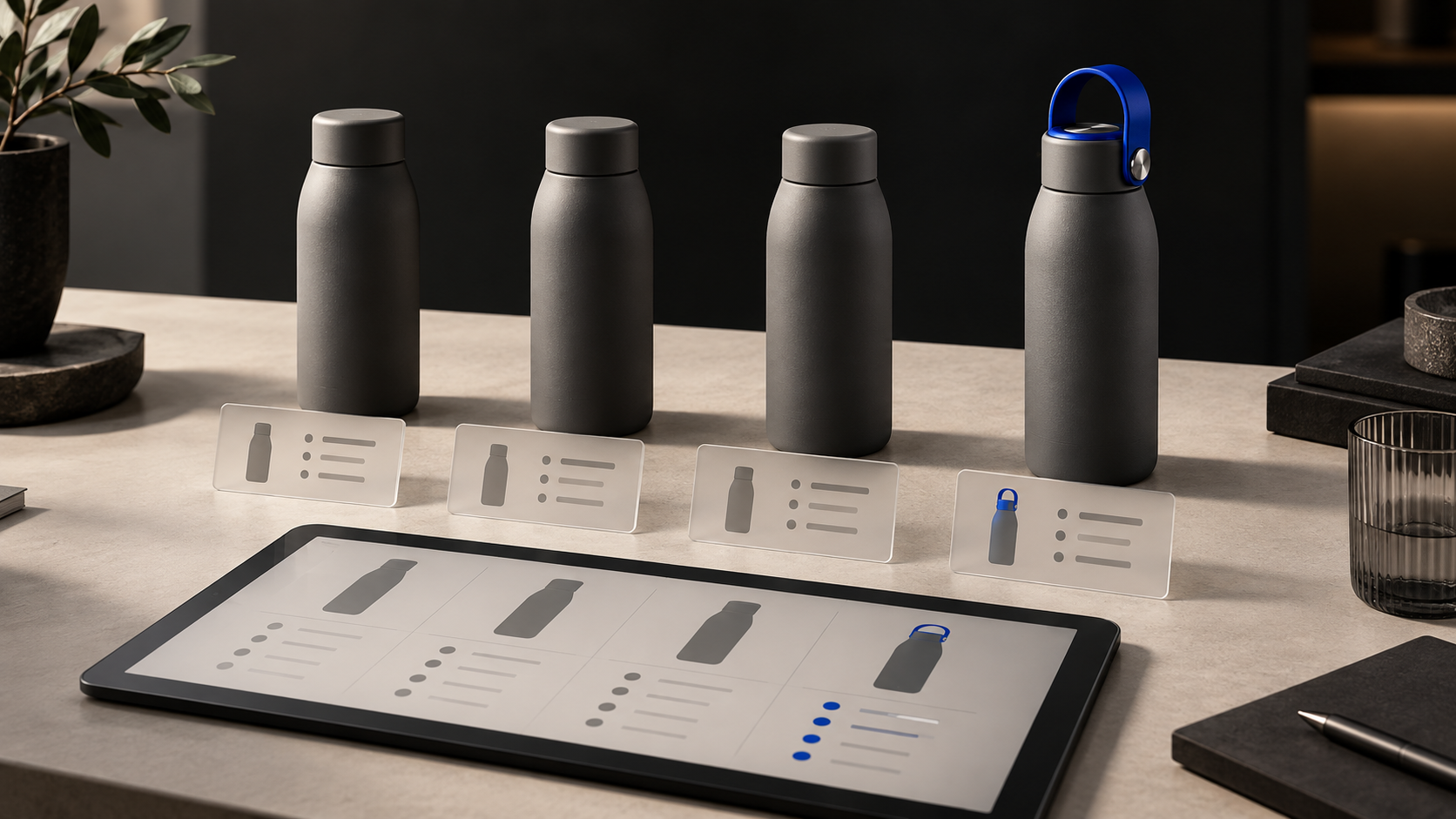
For a long time, many products were harder to compare than they needed to be.
Information lived across different websites. Features were described in different ways. Prices changed by channel. Policies were buried in separate pages. Reviews had to be interpreted one at a time.
The customer had to do the work of putting everything together.
That friction gave brands some cover.
Products that were largely interchangeable could still appear different through positioning, presentation, search visibility, or promotion. A strong campaign could create the impression of distinction even when the product itself offered little that was meaningfully different.
AI makes that harder.
A customer can increasingly describe what they need and ask an agent to find the best options:
“Find me a carry-on suitcase under $300 that is lightweight, durable, easy to repair, and covered by a strong warranty.”
The agent can compare materials, dimensions, prices, reviews, availability, return policies, and warranty terms across multiple brands.
The work that once required ten tabs can begin with one request.
AI does not create commoditization.
It makes existing sameness easier to see.
Comparison is becoming less expensive
Every market contains some amount of artificial distance between similar products.
One brand uses a proprietary name for a common feature. Another creates a new category for a familiar product. A third describes standard functionality as an innovation.
These approaches can work when customers have limited time, incomplete information, and few convenient ways to compare the claims.
AI reduces the cost of that comparison.
It can translate different product descriptions into a common language. It can identify which features are meaningful and which are simply described differently. It can bring policies, pricing, reviews, and availability into the same decision.
That changes the advantage.
It no longer comes from making comparison difficult.
It comes from surviving comparison well.
Claims are not differentiation
Many brands use the same small set of words to describe themselves.
Premium. Innovative. Sustainable. Customer-first. High performance.
Those words can help express a position, but they are not evidence of one.
If several products claim to be durable, an agent can look for material specifications, testing standards, repair options, warranty length, and patterns in customer reviews.
If several brands claim to offer better service, it can compare delivery commitments, return conditions, support availability, and the experiences customers describe publicly.
The stronger claim is the one the brand can support.
An AI agent will not be impressed by a better adjective. It needs a better reason.
That does not mean every difference has to become a specification. Design, taste, identity, trust, and emotional connection still shape what people choose.
But brands will have a harder time using language to create distance that the rest of the experience cannot sustain.
Differentiation has to travel
A meaningful difference cannot exist only in a campaign.
It has to travel through the entire product experience.
The product data should describe it accurately. The website should explain why it matters. The imagery should make it understandable. The reviews should reinforce it. The service model and policies should support it.
An agent may encounter any of those signals before the customer encounters the brand directly.
If the distinction disappears when the product leaves the website, it is not strong enough for an agent-mediated market.
This makes differentiation an operational concern as much as a brand concern.
Marketing cannot invent a promise that product, commerce, service, and data are unable to carry. Product teams cannot build meaningful capabilities that customers—or their agents—cannot discover or understand.
The organization has to agree on what makes the offer different and make that difference visible wherever a decision is being made.
Brand still matters
It would be easy to interpret better product comparison as the beginning of a price-only market.
I do not think that is where this leads.
Customers do not always ask for the least expensive option. They ask for products that fit their circumstances, values, preferences, and tolerance for risk.
They may want the brand with the strongest repair program. The one known for thoughtful design. The one with dependable service. The one they have trusted before.
Brand helps shape the criteria the agent is asked to use.
It creates familiarity before the request and confidence after the recommendation. It gives customers a reason to care about differences that cannot be reduced to price alone.
AI does not make brand irrelevant.
It makes unearned brand claims easier to challenge.
The strongest brands will connect what they mean with what they make, what they say with what they can prove, and what customers remember with what an agent can verify.
The cost of being interchangeable
When a product has no meaningful distinction, the remaining levers become expensive.
The brand can spend more to be seen. It can discount more aggressively. It can increase promotional frequency. It can pay for distribution or placement.
But when AI can compare many options before presenting only a few, visibility alone may not be enough.
This should force teams to ask more difficult questions:
What would remain distinctive if the logo disappeared?
Which differences actually change the customer’s decision?
Can those differences be verified?
Do our product data, policies, reviews, and service experience reinforce the same story?
Would an agent understand why someone should choose us?
These are not only marketing questions.
They are product, experience, operational, and leadership questions.
AI is going to make more products easier to find. It is also going to make similar products easier to recognize as similar.
The brands that benefit will not be the ones that avoid comparison.
They will be the ones that become more convincing when comparison gets easier.
Was this useful?